
Pickleball Injuries: The Most Common Injuries and How Physical Therapy Can Help
Pickleball has become one of the most popular recreational sports in the United States. It is social, accessible, and easier to start than many competitive sports—but that does not mean it is injury-free.
Players can develop pain from repetitive swings, sudden changes in direction, jumping, reaching, or simply doing more activity than their body is prepared to handle.
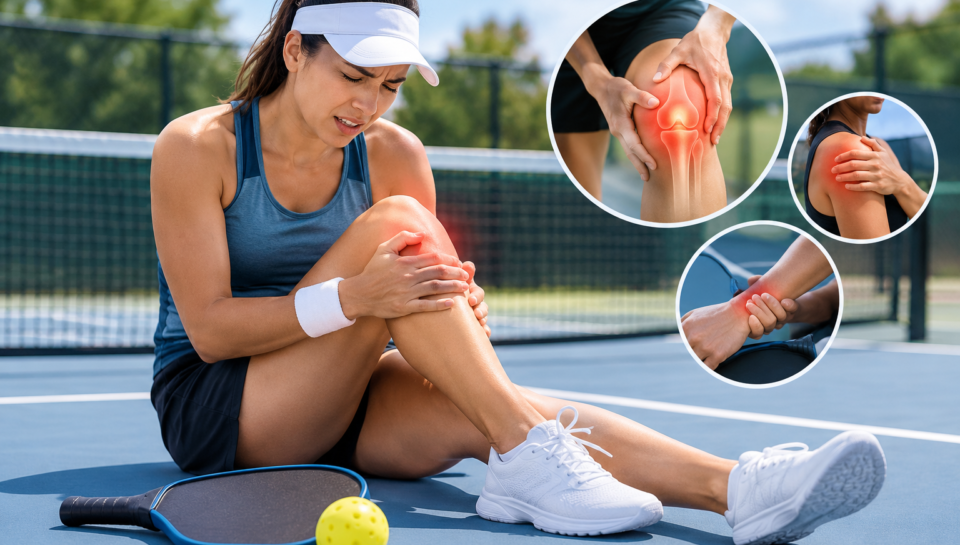
Common problem areas include the shoulder, elbow, wrist, knee, ankle, calf, and Achilles tendon.
The good news is that many pickleball-related problems can be managed successfully with the right combination of activity modification, strengthening, mobility work, and physical therapy.
Why Does Pickleball Cause Injuries?
Pickleball may look low-impact, but the game involves repeated movements that can place stress on different parts of the body.
Players frequently:
- Reach overhead
- Rotate the shoulder and trunk
- Change direction quickly
- Stop and start repeatedly
- Bend and squat
- Lunge toward the ball
- Use repetitive wrist and elbow movements
The problem often occurs when activity increases faster than the body’s ability to adapt.
For example, someone who has not exercised regularly may suddenly begin playing several times a week. Even if each individual game feels manageable, the repeated workload can eventually produce pain.
Common Pickleball Injuries
- Shoulder Pain
Overhead shots and repetitive swinging can place significant demands on the shoulder.
Shoulder problems may cause:
- Pain while serving or hitting overhead
- Difficulty reaching behind your back
- Pain when lifting the arm
- Weakness
- Reduced range of motion
Persistent shoulder pain should not simply be ignored and played through.
- Tennis Elbow or Elbow Pain
Despite its name, tennis elbow can occur in pickleball players.
Repetitive gripping and wrist movements may irritate the tendons around the outside of the elbow.
You may notice pain when:
- Gripping your paddle
- Opening a jar
- Carrying something
- Shaking hands
- Moving your wrist
- Wrist and Hand Injuries
The wrist and hand absorb repeated forces during gripping and paddle control.
Pain may develop from overuse, an awkward shot, or a fall.
Symptoms can include pain, swelling, stiffness, weakness, or difficulty gripping.
- Knee Pain
Pickleball requires repeated squatting, lunging, and lateral movement.
If the muscles around the hips and knees are not adequately prepared, players may experience knee pain during or after playing.
Knee pain that repeatedly returns after activity may be a sign that your movement mechanics, strength, flexibility, or training load need attention.
- Ankle and Achilles Problems
Quick changes of direction can challenge the ankle and lower leg.
A sudden push-off or awkward landing can result in:
- Ankle sprains
- Calf strains
- Achilles irritation
- Muscle soreness
Previous ankle injuries can also increase the chance of future problems if strength and balance have not fully recovered.
Warning Signs You Shouldn’t Ignore
Some soreness after a new activity may be normal. However, you should consider getting evaluated if:
- Pain continues for several days
- Pain repeatedly returns every time you play
- You have swelling
- You notice weakness
- Your range of motion is decreasing
- You are changing how you move because of pain
- You cannot perform normal daily activities comfortably
- Pain is getting progressively worse
Pain that repeatedly interferes with your game is a reason to investigate the underlying problem rather than simply taking longer breaks.
How Physical Therapy Can Help Pickleball Players
Physical therapy is not only for people recovering from major injuries.
A physical therapist can evaluate how you move and identify limitations in strength, flexibility, balance, mobility, or movement coordination.
Treatment may include:
Strengthening
Exercises can target the muscles needed for your sport, including the:
- Rotator cuff
- Shoulder blade muscles
- Forearm
- Core
- Glutes
- Quadriceps
- Hamstrings
- Calves
Mobility Training
Limited mobility can change how your body compensates during movement.
A therapist may address mobility in the shoulder, thoracic spine, hips, ankles, or other areas depending on your symptoms.
Balance and Agility
Balance and controlled movement are especially important for players who frequently move laterally or change direction.
Return-to-Sport Planning
Rather than simply telling you to stop playing, a physical therapist can help develop a gradual return-to-activity plan based on your symptoms and physical capacity.
How Can You Prevent Pickleball Injuries?
You do not have to stop playing pickleball to reduce your injury risk.
Consider:
- Warming up before playing
- Increasing playing time gradually
- Strengthening regularly
- Taking recovery days
- Wearing appropriate footwear
- Staying hydrated
- Working on balance and mobility
- Paying attention to persistent pain
Most importantly, don’t wait until a minor problem becomes severe.
When Should You See a Physical Therapist?
You do not have to give up an activity you enjoy simply because it causes pain.
A personalized rehabilitation program can help you improve strength, mobility, movement control, and confidence so you can work toward returning to the activities you enjoy.
The earlier you address recurring symptoms, the easier it may be to identify contributing factors and develop an appropriate plan.
If your pain is keeping you off the court, consider scheduling a physical therapy evaluation to find out what’s causing the problem and what you can do about it.